Tour Plan
1
Day 1: Meet transfer to hotel:
Meet upon arrival at Entebbe International Airport for a transfer to your hotel near Lake Victoria, booked on Bed & Breakfast basis.
In case of a morning arrival at Entebbe Airport, we proceed to Ssese Island by a speed boat (1hour), to enjoy the breathtaking Lake Victoria sceneries and water birds at our lodge. On the next day, after a first birding session in the pristine forest of Kalangala, we take a 30 minutes boat ride to meet our driver for a short transfer to Masaka & Lake Mburo National Park.
2
Day 2: Kampala or Ssese Island - Lake Mburo National Park:
We embark on a long scenic ride, have lunch and enjoy an unusual equator stop. On arrival at Lake Mburo N.P. (260 km², ranging from 1200 to 1800 meters altitude), we go for a sundown game-drive: an occasion to see elands, zebras, impalas, buffaloes, Rothschild’s giraffes, bushbucks and reedbucks among other mammals. The birdlife is rich in this beautiful savannah park that hosts more than 350 recorded species including the Red-faced Barbet, only seen here and the African Finfoot. Nestle-in at our lodge.
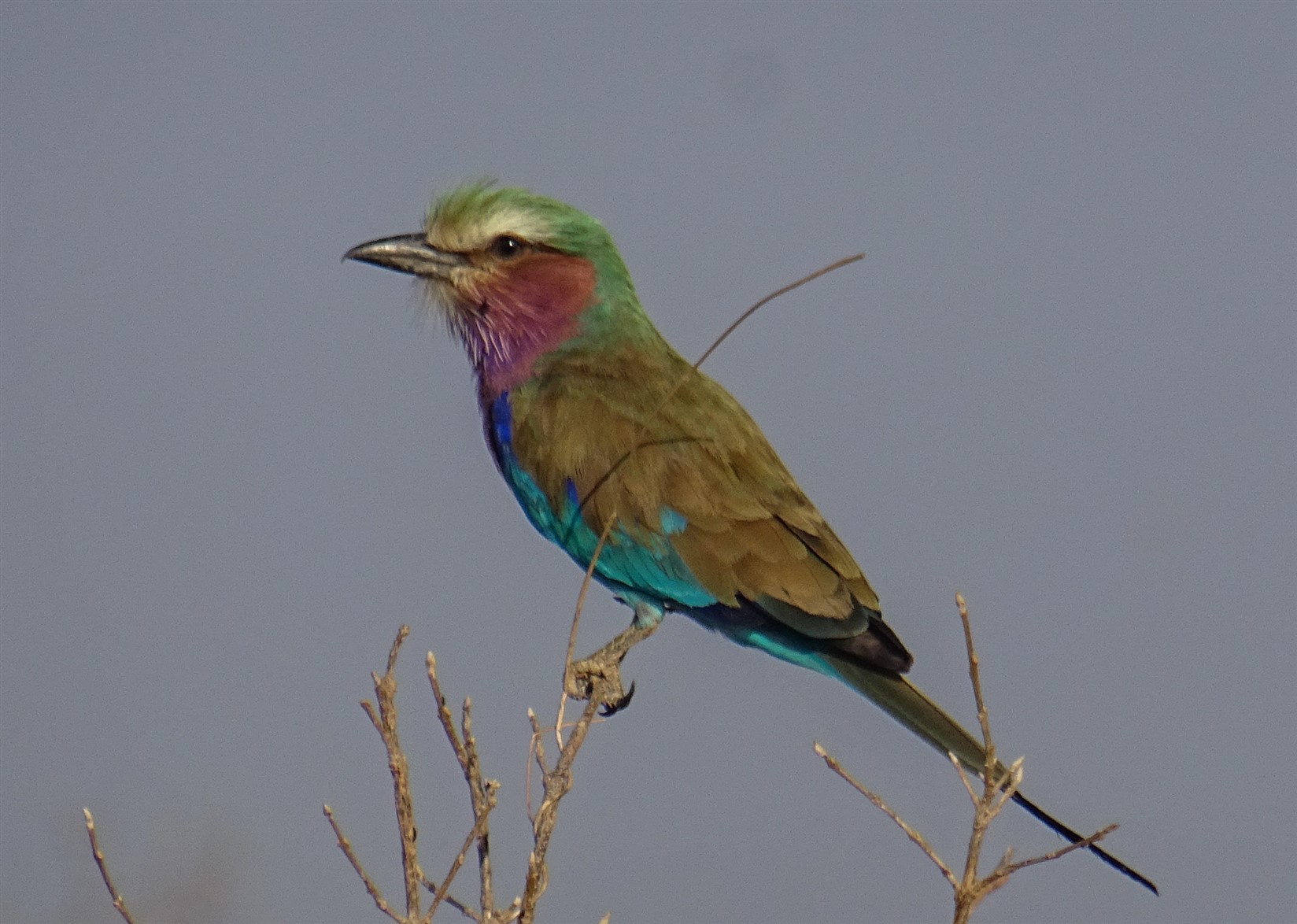
Our birds checklist: African fish eagle, Verreaux’s eagle owl, tropical boubou, green-headed sunbird, bateleur eagle, honey buzzard, osprey, green wood hoopoe, Coqui francolin, African finfoot, black-cuckoo shrike, red-headed weaver, black-bellied bustard, pennant-winged nightjar, laughing dove, green pigeon, brown parrot, red-headed lovebird, Narina’s trogon, paradise flycatcher, bare-faced go-away bird, diaric cuckoo, snowy-headed robinchat, blue-cheecked bee-eater, Ross turaco, crowned hornbill, crowned crane, broad-billed and lilac-breasted rollers, red-faced and spotted-flanked barbets, green-headed sunbird, pygmy and stripped kingfishers, etc. out of 332 species.
3
Day 3: Lake Mburo - Bwindi Impenetrable Forest National Park:
After an early breakfast, we inaugurate a walking safari with a ranger (3 hours on flat open savanna ground), maintaining silence while birding and approaching wildlife. We then take a 6-7hr transfer to Bwindi via the mountainous Bunyankore kingdom with lunch en route. We then check-in for 3 nights at the edge of this incredibly rich pristine rainforest which covers 300 km² and has a dense understorey of fern, vines and shrubs. It is home to 324 tree species, 360 bird species, 120 species of mammals and 300 species of butterflies!
4
Day 4: spend the day in Bwindi, either birding OR tracking Gorillas & birding:
OPTION 1: a full birding day, spent hiking on trails in the forest. Bwindi is a UNESCO Natural World heritage where half of the world’s Mountain Gorillas live. It is also the place to see several of the most unique birds of this trip. Bwindi is a magical place of luxuriant vegetation, an actual rainforest at the junction of the plain and mountain forests spreading across valleys and steep ridges forming the Albertine or Occidental Rift Valley eastern ridge. The forest hosts over 360 species of which 23 are endemic to the Occidental Rift Valley, including the near-mythical African Green Broadbill, handsome Francolin, Rwenzori turaco, Regal Sunbird and Blue-headed Sunbird. After lunch, we also can go for a picturesque walk through the Bakiga countryside and get to see banana farms where beer is extracted, coffee farms, have several visits to a local traditional healer and dispensary, a farmer of our friends and Batwa pygmies.
OPTION 2: a morning gorilla tracking experience & the afternoon spent birding. A chilly and misty morning, prepare for the encounter with the endangered gentle Great Apes! After the briefing, we follow our allocated ranger-guide into the gorilla sanctuary. On sight of the gorillas, we keep calm and watch them feed, play and we fully exploit the strictly one hour allowed in their presence. Bwindi forests are ancient forests with a diversity of flora and fauna for you to see, feel and experience. Back to our lodge, we can spend the afternoon birding in the forest ; we also can pay a visit to a familial group of friendly Batwa pygmies; it is said that this tribe of hunter-gatherers was the first to occupy these forests, today borders between Uganda, Rwanda and Congo.
5
DAY 5: Bwindi - Queen Elizabeth National Park:
After a picturesque transfer via tea farms and superb panoramic vantage points, we access the southern gate of Queen Elizabeth N.P. (covering an area of 1978 km² ranging from 900 to 1350 meters altitude). The Ishasha section is renowned for its tree-climbing lions: we shall employ a network of trails to create viewing avenues of the great predators hanging in Fig trees and Acacia trees. After picnic lunch, we proceed to our lodge, observing many birds and elephants en route…
Our birds checklist: African fish eagle, Pel’s fishing owl, great white pelican, pink-backed pelican, herons ( rufus-bellied + squacco + white-backed night), shoebill and storks (open-billed + saddlebill + yellow-billed), greater & lesser flamingoes, caspian plover, siberian gull, African jacanitsa, African spoonbill, water thick-knee, red-chested cuckoo and yellow-throated green cuckoo, turacos (great blue + Ross + black-billed), hornbills (black-and-white casqued + white thighed + crowned), oliveaceous warbler and barrred warbler, red-chested sunbird, papyrus gonolek and black-headed gonolek, black bee-eater, spotted redshank, African finfoot, etc. out of 610 species (including 54 raptors).
6
Day 6: Queen Elizabeth National Park:
We set about on a sunrise visit to chimpanzees. After a 15 minutes transfer, we attend briefing by our ranger-guide before entering the Chimpanzee sanctuary for our tracking session; in silence, we observe the chimpanzees feeding, having fun and heading to the ground, right in front of us! Also an opportunity for us to observe many colorful birds…
After lunch at our lodge, transfer to the pier for our afternoon private boat-ride on Kazinga Channel: a thread of water which is a lifeline to crocodiles, monitor lizards, a high concentration of hippos and a wide range of water birds. Return and spend the rest of the day game-driving in the wild: the vast savanna plains, swamps and forests of Queen Elizabeth, pocked by 72 extinct young volcanoes, being home to about 95 mammals and over 600 bird-species, we look-out for all the African great fauna.
7
Day 7: Queen Elizabeth - Kibale Forest National Park:
After another sunrise game-drive and a lunch in Kasese, we proceed to Toro subregion. Kibale Forest National Park (766 km², ranging from 1100 to 1600 meters altitude) is home to 13 species of primates and over 339 species of birds. Kibale also contains the highest density and diversity of primates in all of Africa, including over 1500 chimpanzees! We settle-in at our lodge in cottages with a natural forest breeze. We can engage in a birdwatching session before dinner as the birdlife is prolific here.
8
Day 8: Bigodi Swamp & Kibale Forest National Park:
We spend the whole day birding and observing primates in Bigodi swamp and in Kibale forest.
Bigodi Wetland Sanctuary, acting as an important wildlife corridor of Kibale Forest, is a birdwatchers’ paradise ; nicknamed « home of the great blue Turaco », this wetland has about 200 species of birds, including Hornbills, Parrots, Turacos, Cranes, Kingfishers, etc. and is a haven for various mammals (sitatungas, bushbucks, otters, 8 species of primates). We will discover this wildlife through the lush vegetation from the forest pathways, the boardwalks and even atop a tree house tucked high in the canopy. After lunchtime, we explore Kibale forest with a knowledgeable birding ranger.
Our birds checklist: 4 endemics being Nathan’s francolin, masked apalis, blue-headed bee-eater, Cassin’s spintail, and also the elusive and beautiful Great Breast Pitta, the papyrus gonolek, 4 barbets (yellow-billed + grey-throated + yellow-spotted + double-toothed), speckled + yellow-rumped + yellow-throated tinker-barbets, blue-throated roller, bronze sunbird, black-crowned waxbill, great blue turaco, black-and-white casqued hornbill, yellow-bill + brown-eared woodpeckers, grey parrot swamp flycatcher, red-capped + snowy-headed robin-chats, grosbeak + northern brown-throated weavers, etc. out of 339 species.
9
Day 9: Fort Portal - Murchison Falls National Park:
Early scenic transfer to Nkuruba Crater Lake Reserve for a walk with a Mutooro botanist in the deep rain forest (quinine trees, amazing dragon-trees and ficus giant trees); we look for arboreal monkeys, e.g. Red Colobus, Uganda black-and-white Colobus, red-tailed monkeys and amazing birds (great blue turaco, black-and-white casqued hornbill, giant kingfisher, various sunbirds and parrots amongst 100 species recorded in this small but prolific area).
Following snaking routes via villages, we slope down the Western Rift escarpement: overview on the stunning Lake Albert on our way to Murchison Falls N.P., the Uganda's largest National Park, covering an area of 3,840 km2 . Getting its name from the dramatic Murchison Falls, ranging from 620 to 1300 meters altitude, it offers spectacular views of the mighty falls, 451 recorded bird species and 76 mammal species! Murchison Falls, the 9th National Park ranking of Africa’s birding spots protects a variety of untamed Uganda savannah Birding.
Our birds checklist: Martial + African fish eagles, secretary bird, red-necked falcon, marsh harrier, osprey and a variety of bustards, owls & vultures, shoebill, crowned crane, red + goliath herons, great blue turaco, green-breasted pitta, carmine + red-throated bee-eaters, white-thighed hornbill, cattle egret, saddle-billed stork, African jacana, Abyssinian ground hornbill, grey crowned crane, Senegal thick-knee, spur-winged lapwing, balck-billed barbet, swallow-tailed bee-eater, blue-brested + northern carmine bee-eaters, pied + malachite kingfishers, piacpiac, black-headed gonolek, yellow-backed weaver, black-winged red bishop, red-billed + yellow-billed oxpeckers, yellow-mantled widowbird, a variety of migrant waders at the right season, etc. out of 460 species (including 53 raptors).
10
Day 10: Murchison Falls National Park:
We go for an early morning game-drive. Lookout for buffaloes, giraffes, elephants, warthogs, Jackson hartebeasts, lions, leopards and hyenas among others. After lunch, we go for a boat-cruise on the Nile waters to the bottom of Murchison Falls; on the way, lookout for crocodiles, hippos and birds, as the Nile hosts here one of Africa’s densest hippos and crocodiles populations, and a dazzling variety of water birds! The ride finally reveals the spectacular Murchison Falls as the gigantic spillage from a height of 44 meters. At this point, we leave the boat and take an approximately 45 minute hike to the top of the falls. The Nile moves from being almost 80 meters wide to funnel through a 6 meters gorge, creating a mayhem sound and wing of beautiful rainbow.
11
Day 11: Murchison Falls - Ziwa Sanctuary - Kampala:
Early breakfast and we go for our last game-drive, en-route to « Ziwa Rhino Sanctuary », a 70 km² exceptional conservation ranch. This is a special occasion to approach on foot and observe silently the extremely endangered white rhinoceros. After lunch at Ziwa, we proceed to Kampala and our hotel; settle-in for the rest of the evening, enjoying the big pool and the view on the 2nd biggest lake in the world.
12
Day 12: Mabamba Swamp - Entebbe:
After a scenic sunrise on the lake, we embark on a morning Mabamba Swamp exploration by boat, listed as a Ramsar site and an Important Bird Area (a 100 km² marshy bay). Our mellowboat trip will help us locate among many other water-associated species:
Our birds checklist:the shoebill, lesser jacana, blue breasted bee-eater, white-winged warbler, Carruther’s cisticole, Angola swallow, Swamp flycatcher, Olive bellied sunbird, Grey-rumped Swallow, African fish eagle, Long tailed cormorant, Yellow billed Duck, Malachite Kingfisher, Glossy Ibis, White-winged Tern, Hamerkop, White-faced whistling duck, Spur-winged goose, Little Stint, Knobed-billed duck, Great Cormorant, Grey headed gull, Spur-winged Lapwing, Blacl-winged stilt, Madagascar Bee-eater, Yellow-rumped Tinkerbird, Soothy chat, Wayne’s Weaver, Grosbeak Weaver, etc.
Transfer back to Entebbe beaches and a visit to the famous Botanical Garden, if time allows. Proceed to Entebbe airport for your onward flight back home.
13
Possible extension to Kidepo Valley National Park: as following
Day 11: Murchison Falls- Kidepo Valley National Park: We head to the sub-desert savannas, the swamps and the mountains of north eastern Uganda, where Kidepo Valley National Park covers 1500 km² of superb savannas ranging from 900 to 2800 meters altitude, bordering Kenya and Sudan. We settle in bandas and go for our first safari on foot with a ranger: thrills guaranteed when approaching wildlife…
Kidepo Valley N.P., entirely located within the Somali-Masai biome, is the least explored of all Uganda’s parks and yet proves to offer the best as far as ornithological trips are concerned : with its record of up to 480 species in total, making it the 2nd highest after Queen Elisabeth N.P of all the protected areas in the country. Kidepo’s long bird checklist is made even more impressive by the relatively small size of the reserve and the fact that as many as 100 of the birds listed are either dry-country species or else northern or eastern species, which within Uganda are practically confined to Kidepo. Raptors are particularly well represented and other birds must be regarded as Kidepo specials : fox and white-eyed kestrels, carmine, little green and red-thoated bee-eaters, Abyssinian roller, Abyssinian scimitarbill, Karamoja apalis, golden pipit, chestnut weaver, purple grenadier to name only a few of the more colourful and visible species.
Our birds checklist: 56 raptors, including different vultures, secretary bird, bateleur eagle, martial eagle, dark chanting goshawk, tawny eagle, white-eyed kestrel, fox kestrel, plus ostrich, kori bustard, white-bellied go-away bird, bee-eaters (carmine + little green + red-throated), Abyssinian roller, Abyssinian scimitarbill, Karamoja apalis, rufous chatterer, barbets (d’Arnauds + red-and-yellow + black-breasted), hornbills (Jackson’s + yellow-billed + red-billed), African black coucal, purple grenadier, northern brownbul, buffalo weavers (red-billed and white-headed), golden pipit, chestnut weaver, etc. out of 480 species.
Days 12 & 13: Kidepo Valley National Park: 2 full days exploring this spectacular scenic reserve, lost alone on the mountainous borders of Sudan and Kenya, where the many distinct biotopes conceal a multitude of animal species. In addition to the « great classics » of lions, leopards, elephants, buffaloes, giraffes and spotted hyenas, we can meet the majestic greater kudu, the elusive serval cat, the imposing eland, the facetious bat-eared fox, the astonishing aardwolf amongst 80 species of mammals, plus 480 of birds.
Please note : depending on your flight schedule, we might leave Kidepo by mid-afternoon and proceed to Kitgum for the last night.
Day 14: Kidepo Valley OR Kitgum- Kampala - Entebbe airport: if you fly late evening, after our early breakfast, we go for a last game-drive, en-route to Kampala and Entebbe beaches and//or a visit to the famous Botanical Garden, if time allows. Proceed to Entebbe airport for your onward flight back home.
Gallery